The field manual
How to Play
Everything the expedition knows, written down. None of it is required reading — the game explains itself as you go — but some people like to study the charts before they sail. This page is for them.
Before you set out
Expedition is a treasure hunt played on foot in the real world. The game only does anything when you are somewhere, so the first requirement is a pair of shoes. The rest of the kit:
- An iPhone or iPad running iOS 18 or later.
- A connection. The expedition office keeps the ledger; without a signal the app shows a calm little Off the grid notice and waits with you.
- Your location, while the app is open. Expedition needs to know where you are before it can tell you what is buried there. It never reads your location in the background — there is no reason to.
There is no account to create. No email, no password, no sign-in with anything. Your expedition lives under a key the app makes for itself on first launch — more on that at the end.
Your first find
The game opens by asking one question: What shall we call you? Every expedition keeps a record of who found what, so pick a name fit for the archives. It appears on museum plaques as the finder, and you can change it later in Settings.
The ground makes sure a new explorer always finds something worth carrying. When it turns up, the game explains the one rule that matters: Nobody knows exactly what you've discovered yet, including you. Pick it up and a snapshot goes straight to the Professor. Carry it while he works and the discovery is credited to you, on a brass plaque, forever. Drop it early and someone else might get all the glory.
After your first pickup — and only then — the app asks whether you would like reminders. It will never ask at launch, and nothing ever nags you while you are playing.
Exploring
The home screen is a map of where you are standing, drawn like an old chart under glass. Under it sits one leather button: Explore. Tap it and the ground answers.
The movement rule
You get a few looks around any one spot, and then the game asks you to walk on. Civilian GPS cannot reliably tell ten feet from standing still, so Expedition does not pretend otherwise. The game simply prevents you from picking over the same patch of ground forever. Walking a proper distance gives you your looks back, and traveling farther improves your odds. The game never shows you a counter; it just lets you look until there is nothing left to look at, then says so: “You have had a good look around this spot. Walk on a bit and try again.”
Good hunting grounds
The map marks real points of interest near you — parks, gardens, monuments, museums, fountains, viewpoints, markets. The Professor's maps have a mark by places like these: hunting improves within sight of one. When the boost is actually in effect, a small gold note appears under the map so you can feel the mechanic working rather than take it on faith.
Patience pays
Leave an area alone for a full day and it forgets you. Your odds of turning up an artifact improve noticeably on the first search after a day away. If you allow reminders, the app sends exactly one note when your luck turns.
What you can find
Four things come out of the dirt, in roughly this order of likelihood:
- Gold. Most searches turn up a handful of coins. Gold is the working currency you can use to get gear at The Outfitter's Shop.
- Artifacts. Now and then you find a real piece, which remains unnamed and undescribed (except for what your own eyes can tell you). Artifacts are the heart of the game; they go to the Professor.
- Crystals. Once in a long while a crystal turns up loose in the dirt. It goes straight in your pocket. Spend it hurrying the Professor along, putting your name on a museum wing, or on other useful benefits.
- Precious gems. These are the rarest things in the game, by a wide margin. A gem goes off to a gemologist and comes back with a name and a color all its own. See Gems and crystals.
Search too fast and the game tips its hat — “Slow down there, little traveler! Give it a moment before searching again.” — and the Explore button itself recharges under a receding paper veil, so you always know when it is ready without reading a number.
Your pack
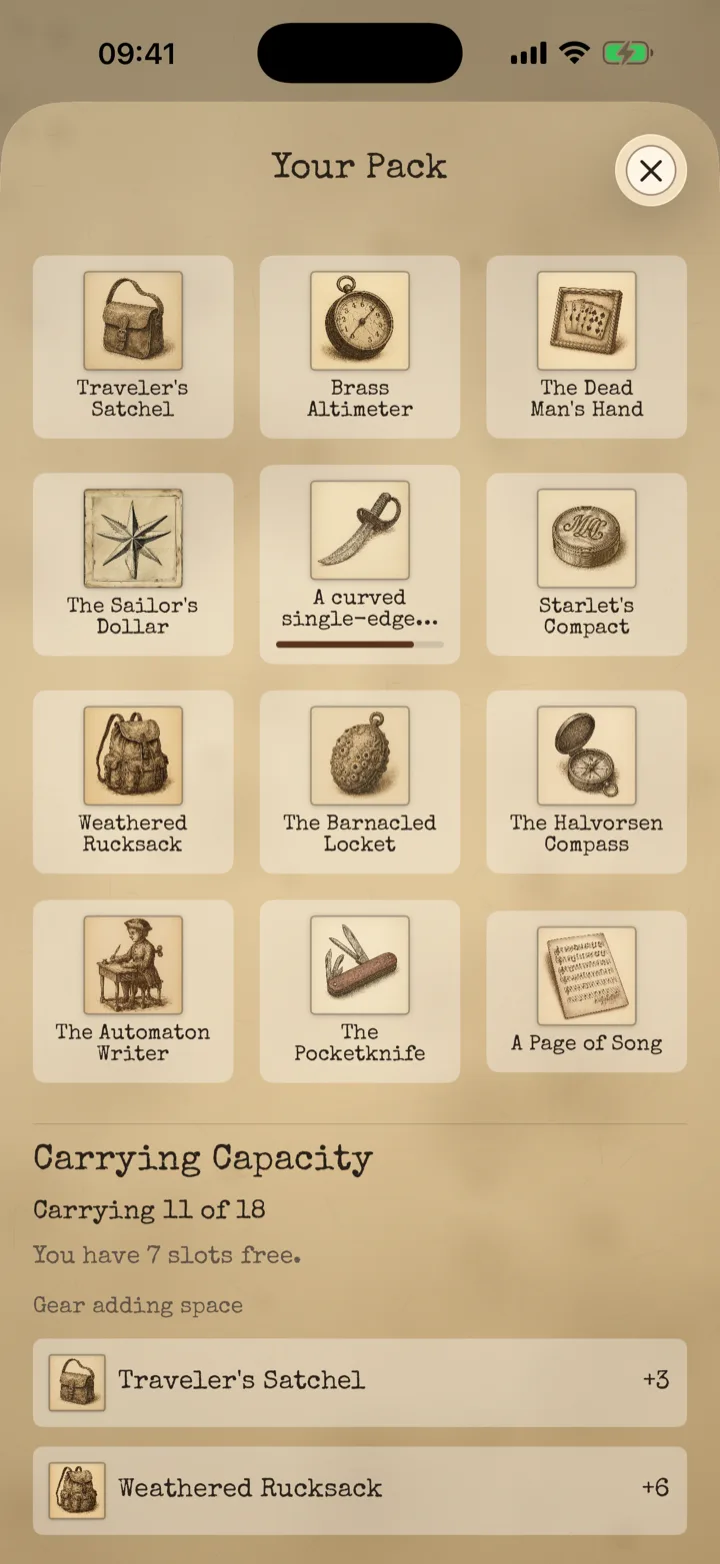
Everything you carry takes room. You start with nine spots. Each artifact takes a spot — heavy pieces take more — and so does every gem you decide to keep.
Gear creates room to carry more. Rucksacks, satchels, and steamer trunks from The Outfitter's Shop add to your carrying capacity. A Traveler's Satchel adds three; a Weathered Rucksack adds six; the trunks go up from there. Buying gear is usually the best gold you will ever spend.
When the pack is full and the ground offers you something anyway, the find waits right where it is. The game holds it for you while you make room, and only for you. Set something down, walk back, and pick it up. Or buy a bigger bag on the spot and take it home the easy way.
You can view your items as a list or as cards, whichever suits you, and the museum uses the same choice. Visit your Settings to switch.
The Professor
A new artifact has no name — only a description — until the Professor is finished with it. How long that takes depends on the piece: most take about three days, some are quicker, the remarkable ones take the better part of a week.
While he works, the artifact's card shows the accession meter: Stage 3 of 6 — Cross-referencing, a leather bar creeping along, and a note on how the work is going. By stage five the notes get interesting: “The Professor has an opinion at last. It might be a big one.”
The one rule: carry it the whole time. Set it down before the Professor is finished and the work stops there — no name, no credit, and the next person along gets the find.
When the hold ends — wherever you are in the app — the news arrives: “The Professor is finished. You have been credited with discovering the Sailor's Dollar!” The piece takes its true name, joins its wing of the museum, and gets a brass plaque with your name as the finder and the date it entered the collection. The plaque is mounted with four slotted screws at four different angles, because no museum's handyman ever lines them up.
If you cannot stand the wait, one crystal buys a day off the Professor's time. It works as often as you like, on as many pieces as you like. He pockets the crystal and picks up the pace.
Gems and crystals are not the same thing
The game deliberately uses two different words for two different things, and mixing them up is the classic new-explorer mistake.
Precious gems are treasure. A gem arrives under a lot number and goes to a gemologist, who works at their own pace — there is no paying to speed this up, not for any price. It comes back named: the Orb of Smithtown, Mortimer's Sapphire of Certain Ruin, the Carbuncle of the Yangtze. Every stone's name is unique in the entire game, forever. A named stone is worth 1,000 gold to a dealer — or nothing at all, if you would rather keep it. Selling is permanent, and the name goes with it: nobody will ever find another one called that. Named stones keep one more secret, too, but you will have to find that one yourself.
Crystals are money. They hurry the Professor and put your name on a museum wing, and that is all they do. They turn up loose in the dirt while exploring, and the outfitter keeps a case behind the counter. They are never worth gold — the gems you dig up are the valuable thing, and that is the whole difference between them.
The Museum
Every artifact you find is cataloged in the museum for good, sorted into themed wings. Dropping — or even selling — a piece never erases the record: the museum remembers everything you have ever discovered, even when the piece itself is in another adventurer's hands.
The museum keeps its rooms dark until you earn the light. Only wings you already have a piece in appear on the board; the rest are not even named. At the bottom, a quiet line keeps score: “The museum has more rooms than you have found.” There are twenty-four in all, and every first find from an unknown wing switches one more light on.
Each wing shows how many of its pieces you hold and the wing bonus its patrons will pay when you complete it — five hundred gold for the humble Starter Satchel, a few thousand for the grand halls. Completing a wing is the only thing in the game that pays twice: once in gold, once in lasting renown.
Museum patronage
Museums let their patrons put a name on a wing, and this one is no different: one crystal renames any wing you have discovered, with a live brass plaque drawn as you type. The David Gagne Cartographers' Wing has a certain ring to it. The rename is entirely private to your own museum — nobody else ever sees it.
The Treasure wing
One special room lists the rarest things the ground has ever given up: every named stone in the game, richest first, each drawn in its own color — who holds it, and where the lost ones were last seen. The rows are records, not doors. It is the closest thing the expedition has to a hall of fame.
Setting things down
Anything you carry can be set down, and the game always asks before letting you. What happens next is the interesting part:
- Dropped things stay exactly where you set them down. Another explorer standing on that spot can find and take them. This is the closest the game gets to multiplayer, and it works best in places people actually walk.
- Ignoring a find is the same as dropping it — it goes back to the ground at once, for anyone.
- Every artifact carries its history. A piece's card draws its provenance as a red line on an old chart: where it first surfaced, every hand it has passed through, every place it was set down and found again. If a previous holder has left the expedition entirely, the record notes their fate — the archive mentions at least one explorer swallowed by quicksand.
- Dropping gear shrinks your pack by whatever it was adding, so the game will not let you abandon a trunk your pack cannot spare.
- A finished piece is safe to set down. Once the Professor has named it, the credit is yours forever — you carry it only if you are particularly fond of it. Some things are lucky.
About that last line: some artifacts are lucky to carry, and a few are quietly the opposite. The effect is small on any single search and considerable over a hundred of them. Nothing in the game tells you which is which, or by how much. That is deliberate.
The Professor's List
Each morning, a wax-sealed envelope arrives from the office of the Professor, addressed to you by name. Inside is a typed index card: three light errands for the day. Search near a couple of landmarks, stretch your legs between digs, look in on the museum — that sort of thing.
The list is observed, not performed. You never have to do anything special — just play, and the Professor notices, ticking items off with a quiet note under your search results. Each errand pays a little gold; finish all three and the day counts toward a streak; a full week of completed days earns a crystal, sent with his compliments.
The envelope is pure theatre and it knows it — it waits politely while you read your own name, opens with a tap, and steps out of the way. If your device asks for reduced motion, the theatre respectfully skips itself.
My Travels
From your second search onward, the map icon opens your whole history: every place you have ever searched, drawn as a red route across an aged chart, animated with a camera that dives to your first dig and pulls back at the end to show the entire journey. The pacing follows real geography — short hops stay visible, long hauls glide.
The journey is yours to name (the pencil is on the title), and yours to keep:
- Poster — a framed, sepia-toned print of the whole route with your title on it, sized for sharing.
- Video — the same show rendered as a short film, saved to the Files app under On My iPhone, ready for wherever short films go.
The stats capsule keeps honest count — 93 searches · 3,553.7 miles — in miles or kilometers, whichever you prefer.
The Outfitter's Shop
Nobody knows his name. He was here before the museum was, and he will be here after, and every expedition that has ever set out from this town has set out carrying something he sold them.
He deals in room: rucksacks, trunks, and a great deal of rope. Whatever you buy adds spots to your pack instead of filling them, which is the only reason anyone ever comes back a second time. Prices are in gold — the coins come out of the ground, the gear goes on your back, and the game's whole economy walks on its own two feet.
He also keeps a few crystals in his back pocket, if you are willing to pay his price: A Pocketful, A Satchelful, or A Strongbox, bought with real money through the App Store. That is the entire catalog of things money can buy. There are no subscriptions, no ads, and nothing on sale that plays the game for you — crystals only ever buy patience and vanity, and the outfitter would be the first to tell you that neither is required.
Your expedition and your key
There is no account. Your device holds a key, and that key is your expedition's log — every artifact, gem, crystal, and coin, your museum and your history.
The key travels on your iCloud Keychain, so any device signed into your Apple Account shares one expedition: play on the iPhone at lunch and the iPad at night, same museum. With iCloud Keychain switched off, the key stays on one device only — playing on a new device would start you over, and there is no way for anyone to give the old expedition back. If that worries you, check Settings → your name → iCloud → Passwords on your device.
The pleasant side of this arrangement: there is nothing personal to lose, leak, or be asked to delete. No email, no password, no profile. A kid can play. See the privacy page for the whole story — it is short, because there is not much to tell.
Field manners & tips from the trail
- Play where you already walk. The dog's route, the way to school, the lunch loop. Expedition is built for a minute or two at a time, not for sessions.
- Head for the marks on the chart. Parks, monuments, and places with a past genuinely pay better, and the gold note under the map tells you when you are standing in the good stuff.
- Buy the rucksack. Early gold goes furthest at the outfitter. A bigger pack means never leaving a find behind while the Professor is mid-thought.
- Finish what you carry. A dropped accession is gone for good — if the wait chafes, that is what crystals are for.
- Let the ground rest. A day away turns your luck; the first dig after a break is the one to savor.
- Check the morning mail. The Professor's List pays for things you were probably going to do anyway, and the streak crystal is the steadiest one in the game.
- Watch the docks and the squares. Other explorers drop things where people actually walk — a busy plaza is worth a look on principle.
- Do not worry about your battery. Expedition reads your location only while it is open on screen. There is no background tracking, and no reason for it.
That is everything in the manual. The rest is in the ground.
Join the Beta on TestFlight Free while in beta, through Apple's TestFlight app. iPhone and iPad, iOS 18 or later.